
sábado, junio 15, 2013


Jorge Luis Borges - a small tribute from a devoted reader
This is an unusual entry in my blog as it's in English but there's a reason for this. I know that there are visitors to my blog from other countries, notably one from Nepa and another from Mountain View California (but I guess this visitor understands Spanish pretty well), and maybe they don't speak or understand Spanish or their knowledge of the language is limited. So today, I'd like to share this small tribute to Jorge Luis Borges, my favourite writer, writing in English so that they can have at least a tasting of his work if they haven't read hime before. If you are interested in his life and works, I may recommend Edwin Williamson's biography "Borges: a life".
Jorge Luis Borges was born in Buenos Aires, Argentina on August 24, 1899. Shortly after his birth, his family relocated to Palermo, a suburb on the northern outskirts of the city named after the capital of Sicily. Although now Palermo is a well-developed area with a high cost of living, at the turn of the century it was a lower class suburb known for its vaguely seedy underclass, discordant politics, and knife-wielding compadrito, or hoodlums. A suburb containing its share of whorehouses and cabarets, it could be an often violent place where the residents danced the tango and told stories aflame with gauchos and knife fights. Although the flavor of this neighborhood was to permanently enter Borges's later writing, at the turn of the century the middle-class Borges family felt distinctly out of place.
As a middle class child living in Palermo, he was essentially a bookish and terribly nearsighted child who tended to hide indoors. And yet in the manner common to all boys everywhere, in his imagination he fancied himself to be an active part of the local scenery. He established a friendship with a local poet, his neighbor Evaristo Carriego, a reckless man who represented much of the "sentimental machismo" of Argentine tradition and would become something of a minor idol to the young dreamer. It wasn't until much later, returning to Buenos Aires after spending seven years in Europe, that Borges admitted to himself that "for years I believed I had grown up in a suburb . . . of risky streets and visible sunsets. The truth is I grew up in a garden, behind lanceolate railings, and in a library of unlimited English books." He later wrote a small book on the poet Carriego in which he reconciles the fact that his younger self was no denizen of the streets, but rather a quiet intellectual. Nevertheless, images of the compadrito, stray gauchos, and knife fights would make their occasional appearances throughout the rest of his literary career.
Although it was the 1940's that first gave Borges the glimmer of international fame, when his works were translated into French, it wouldn't be until 1961 that he would gain genuine world-wide recognition. That year he and Samuel Beckett were jointly awarded the second-ever International Publishers Prize, the Formentor Prize, and he found that the global spotlight was suddenly turned upon him. His work was translated into English, and all at once he became in demand. Ficciones was translated into several languages and made its way into many countries, becoming the first Latin American work to achieve such attention. He was invited to the University of Texas, and in 196 he experienced the United States for the first time, a country that he had always considered in semi-mythic proportions. He spent six months travelling, lecturing at universities from San Francisco to New York. He would visit the United States numerous times over the rest of his life, giving lectures, readings, and informal discussions.
In 1963 he travelled again to Europe, revisiting many locations from his childhood memories and meeting again with old friends and associates, and in 1967 he was invited by Harvard to spend a year in the U.S. as a visiting professor. He wrote many more volumes of poetry, and a few collections of short stories and essays. In 1967, he and his friend Bioy Casares published another "Bustos Domecq" book, The Chronicles of Bustos Domecq. In 1970 a collection of stories came out, El Informe de Brodie, "Dr. Brodie's Report." In 1973 he decided to spend the next few years travelling and lecturing, producing another collection of stories, El libro de arena, or "The Book of Sand" in 1975.

Fotógrafo: José María Pepe Fernández (1929-2006), 1969 Paris.

The tombstone is fascinating as it reveals a lot of Borges' world. On his tombstone are inscriptions in Old English and Old Norse and a single enigmatic line in Spanish. What is going on here?The face of the stone depicts a scene of warriors in armor that echoes the Lindisfarne gravestone, which probably depicts memories of a raid by Vikings in 793. “Jorge Luis Borges” curves over the top of the stone. Underneath the words “…and ne forhtedon na”, then the dates, “1899 1986″ with a small Celtic cross shaped like that at Gosforth.

Spinoza knew that all things long to persist in their being; the stone eternally wants to be a stone and the tiger a tiger. I shall remain in Borges, not in myself (if it is true that I am someone), but I recognize myself less in his books than in many others or in the laborious strumming of a guitar. Years ago I tried to free myself from him and went from the mythologies of the suburbs to the games with time and infinity, but those games belong to Borges now and I shall have to imagine other things. Thus my life is a flight and I lose everything and everything belongs to oblivion, or to him.
I do not know which of us has written this page.
The Art of Poetry
To gaze at a river made of time and water
and remember Time is another river.
To know we stray like a river
and our faces vanish like water.
To feel that waking is another dream
that dreams of not dreaming and that the death
we fear in our bones is the death
that every night we call a dream.
To see in every day and year a symbol
of all the days of man and his years,
and convert the outrage of the years
into a music, a sound, and a symbol.
To see in death a dream, in the sunset
a golden sadness--such is poetry,
humble and immortal, poetry,
returning, like dawn and the sunset.
Sometimes at evening there's a face
that sees us from the deeps of a mirror.
Art must be that sort of mirror,
disclosing to each of us his face.
They say Ulysses, wearied of wonders,
wept with love on seeing Ithaca,
humble and green. Art is that Ithaca,
a green eternity, not wonders.
Art is endless like a river flowing,
passing, yet remaining, a mirror to the same
inconstant Heraclitus, who is the same
and yet another, like the river flowing.
--translated by Anthony Kerrigan
Jorge Luis Borges was born in Buenos Aires, Argentina on August 24, 1899. Shortly after his birth, his family relocated to Palermo, a suburb on the northern outskirts of the city named after the capital of Sicily. Although now Palermo is a well-developed area with a high cost of living, at the turn of the century it was a lower class suburb known for its vaguely seedy underclass, discordant politics, and knife-wielding compadrito, or hoodlums. A suburb containing its share of whorehouses and cabarets, it could be an often violent place where the residents danced the tango and told stories aflame with gauchos and knife fights. Although the flavor of this neighborhood was to permanently enter Borges's later writing, at the turn of the century the middle-class Borges family felt distinctly out of place.
As a middle class child living in Palermo, he was essentially a bookish and terribly nearsighted child who tended to hide indoors. And yet in the manner common to all boys everywhere, in his imagination he fancied himself to be an active part of the local scenery. He established a friendship with a local poet, his neighbor Evaristo Carriego, a reckless man who represented much of the "sentimental machismo" of Argentine tradition and would become something of a minor idol to the young dreamer. It wasn't until much later, returning to Buenos Aires after spending seven years in Europe, that Borges admitted to himself that "for years I believed I had grown up in a suburb . . . of risky streets and visible sunsets. The truth is I grew up in a garden, behind lanceolate railings, and in a library of unlimited English books." He later wrote a small book on the poet Carriego in which he reconciles the fact that his younger self was no denizen of the streets, but rather a quiet intellectual. Nevertheless, images of the compadrito, stray gauchos, and knife fights would make their occasional appearances throughout the rest of his literary career.
Although it was the 1940's that first gave Borges the glimmer of international fame, when his works were translated into French, it wouldn't be until 1961 that he would gain genuine world-wide recognition. That year he and Samuel Beckett were jointly awarded the second-ever International Publishers Prize, the Formentor Prize, and he found that the global spotlight was suddenly turned upon him. His work was translated into English, and all at once he became in demand. Ficciones was translated into several languages and made its way into many countries, becoming the first Latin American work to achieve such attention. He was invited to the University of Texas, and in 196 he experienced the United States for the first time, a country that he had always considered in semi-mythic proportions. He spent six months travelling, lecturing at universities from San Francisco to New York. He would visit the United States numerous times over the rest of his life, giving lectures, readings, and informal discussions.
In 1963 he travelled again to Europe, revisiting many locations from his childhood memories and meeting again with old friends and associates, and in 1967 he was invited by Harvard to spend a year in the U.S. as a visiting professor. He wrote many more volumes of poetry, and a few collections of short stories and essays. In 1967, he and his friend Bioy Casares published another "Bustos Domecq" book, The Chronicles of Bustos Domecq. In 1970 a collection of stories came out, El Informe de Brodie, "Dr. Brodie's Report." In 1973 he decided to spend the next few years travelling and lecturing, producing another collection of stories, El libro de arena, or "The Book of Sand" in 1975.

In addition to short stories, Borges also wrote poetry, essays, screenplays, literary criticism, and edited numerous anthologies. His longest work of fiction is a 14-page story, "The Congress", first published in 1971. His late-onset blindness strongly influenced his later writing. Borges wrote: "When I think of what I've lost, I ask, 'Who know themselves better than the blind?' – for every thought becomes a tool.". His most important intellectual interests are elements of mythology, mathematics, theology, integrating these through literature, sometimes playfully, sometimes with great seriousness.
Borges composed poetry throughout his life. As his eyesight waned, he increasingly focused on writing poetry, since he could memorize an entire work in progress. His poems embrace the same wide range of interests as his fiction, along with issues that emerge in his critical works and translations, and from more personal musings. For example, his interest in idealism pervades his work, reflected in the fictional world of Tlön in "Tlön, Uqbar, Orbis, Tertius" and in his poems "Things" and "The Golem" and his story "The Circular Ruins".
He died in Geneva 14 June 1986 and was buried in the Cimetière des Rois.

The tombstone is fascinating as it reveals a lot of Borges' world. On his tombstone are inscriptions in Old English and Old Norse and a single enigmatic line in Spanish. What is going on here?The face of the stone depicts a scene of warriors in armor that echoes the Lindisfarne gravestone, which probably depicts memories of a raid by Vikings in 793. “Jorge Luis Borges” curves over the top of the stone. Underneath the words “…and ne forhtedon na”, then the dates, “1899 1986″ with a small Celtic cross shaped like that at Gosforth.

The Gosforth cross
“And ne forhtedon na” is Old English for “Be not afraid” and is a quote from the poem “The Battle of Maldon” which Borges translated and often discussed.The reverse of the stone depicts a Viking ship, possibly derived from a Gotland runestone. In Norse thought, ships were associated with death, that last great voyage into the unknown. Above the ship is a line from the Old Norse Volsunga Saga: “Hann tekr sverthtt Gram ok leggri methal their abert”. Sigurd, who is disguised as Brynhild’s husband, lies down beside her: “He took the sword Gram and laid the naked metal between them.”Underneath the ship are the words: “De Ulrica a Javier Otárola”. Ulrikka and Javier are characters in Borges’ story “Ulrikka” which is pefaced by the earlier lines from Volsunga Saga. The story is about the romance between a young Norwegian woman and an older man in York.
"Borges and I" by Jorge Luis Borges
The other one, the one called Borges, is the one things happen to. I walk through the streets of Buenos Aires and stop for a moment, perhaps mechanically now, to look at the arch of an entrance hall and the grillwork on the gate; I know of Borges from the mail and see his name on a list of professors or in a biographical dictionary. I like hourglasses, maps, eighteenth-century typography, the taste of coffee and the prose of Stevenson; he shares these preferences, but in a vain way that turns them into the attributes of an actor. It would be an exaggeration to say that ours is a hostile relationship; I live, let myself go on living, so that Borges may contrive his literature, and this literature justifies me. It is no effort for me to confess that he has achieved some valid pages, but those pages cannot save me, perhaps because what is good belongs to no one, not even to him, but rather to the language and to tradition. Besides, I am destined to perish, definitively, and only some instant of myself can survive in him. Little by little, I am giving over everything to him, though I am quite aware of his perverse custom of falsifying and magnifying things.Spinoza knew that all things long to persist in their being; the stone eternally wants to be a stone and the tiger a tiger. I shall remain in Borges, not in myself (if it is true that I am someone), but I recognize myself less in his books than in many others or in the laborious strumming of a guitar. Years ago I tried to free myself from him and went from the mythologies of the suburbs to the games with time and infinity, but those games belong to Borges now and I shall have to imagine other things. Thus my life is a flight and I lose everything and everything belongs to oblivion, or to him.
I do not know which of us has written this page.
Jorge Luis Borges
and remember Time is another river.
To know we stray like a river
and our faces vanish like water.
To feel that waking is another dream
that dreams of not dreaming and that the death
we fear in our bones is the death
that every night we call a dream.
To see in every day and year a symbol
of all the days of man and his years,
and convert the outrage of the years
into a music, a sound, and a symbol.
To see in death a dream, in the sunset
a golden sadness--such is poetry,
humble and immortal, poetry,
returning, like dawn and the sunset.
Sometimes at evening there's a face
that sees us from the deeps of a mirror.
Art must be that sort of mirror,
disclosing to each of us his face.
They say Ulysses, wearied of wonders,
wept with love on seeing Ithaca,
humble and green. Art is that Ithaca,
a green eternity, not wonders.
Art is endless like a river flowing,
passing, yet remaining, a mirror to the same
inconstant Heraclitus, who is the same
and yet another, like the river flowing.
--translated by Anthony Kerrigan
jueves, junio 13, 2013
Día del Escritor - Argentina
Todos los 13 de junio se conmemora en la Argentina el Día del Escritor. No es una fecha casual y encuentra su explicación en que el mismo día, pero de 1874, nació Leopoldo Lugones en Villa María del Río Seco, en la provincia de Córdoba. Entre muchas de las acciones y obras que emprendió, Lugones fundó la Sociedad Argentina de Escritores (SADE) que, luego del suicidio del poeta, estableció el día de su natalicio como el Día del Escritor. Lugones no fue olvidado pero su tumultuoso y resonante paso terrenal es aún materia de controversia y polémica, sin embargo, corresponde reconocer en él a un precursor y a un hombre clave en la configuración del canon literario argentino..

A raíz de un revés de fortuna de su familia, se trasladó muy joven a Buenos Aires donde inició una clamorosa carrera como intelectual bajo el pseudónimo de "Gil Paz". Ardorosamente discutido o ensalzado desde entonces, su actividad la ejerció también en el periodismo, ocupando varios cargos en su país y en el exterior, que lo llevaron a radicarse en Paris en 1924.En 1938 con enorme y trágica sorpresa de quienes lo querían y admiraban, se quitó la vida en Buenos Aires.
Su obra mas conocida es quizás «La Guerra Gaucha», un libro de relatos sobre los gauchos que comandados por Martín Miguel de Güemes lucharon contra España durante laguerras de independencia, entre 1815 y 1825. Está escrito en lenguaje gauchescoy resulta difícil de entender para los no iniciados. La fuerza de los relatos y su naturaleza épica lo hizo un libro sumamente exitoso.
Lugones escribió poesía y cuento. Experimenta con cuentos de misterio en con su obra Las fuerzas extrañas; este libro junto con Cuentos fatales son considerados precursores de la narrativa breve en Argentina, que tendrá una vasta tradición a lo largo de todo el siglo XX.
ELEGÍA CREPUSCULAR
Desamparo remoto de la estrella,
hermano del amor sin esperanza,
cuando el herido corazón no alcanza
sino el consuelo de morir por ella.
Destino a la vez fútil y tremendo
de sentir que con gracia dolorosa
en la fragilidad de cada rosa
hay algo nuestro que se está muriendo.
Ilusión de alcanzar, franca o esquiva,
la compasión que agonizando implora,
en una dicha tan desgarradora
que nos debe matar por excesiva.
Eco de aquella anónima tonada
cuya dulzura sin querer nos hizo
con la propia delicia de su hechizo
un mal tan hondo al alma enajenada.
Tristeza llena de fatal encanto,
en el que ya incapaz de gloria o de arte,
sólo acierto, temblando, a preguntarte
¡qué culpa tengo de quererte tanto!
Heroísmo de amar hasta la muerte,
que el corazón rendido te inmolara,
con una noble sencillez tan clara
como el gozo que en lágrimas se vierte.
Y en lenguaje a la vez vulgar y blando,
al ponerlo en tus manos te diría:
no sé cómo no entiendes, alma mía,
que de tanto adorar se está matando.
¿Cómo puedes dudar, si en el exceso
de esta pasión, yo mismo me lo hiriera,
sólo porque a la herida se viniera
toda mi sangre desbordada en beso?
Pero ya el día, irremediablemente,
se va a morir más lúgubre en su calma:
y más hundida en soledad mi alma,
te llora tan cercana y tan ausente.
Trágico paso el aposento mide....
Y al final de la alameda oscura,
parece que algo tuyo se despide
en la desolación de mi ternura.
Glorioso en mi martirio, sólo espero
la perfección de padecer por ti.
Y es tan hondo el dolor con que te quiero,
que tengo miedo de quererte así.
Desamparo remoto de la estrella,
hermano del amor sin esperanza,
cuando el herido corazón no alcanza
sino el consuelo de morir por ella.
Destino a la vez fútil y tremendo
de sentir que con gracia dolorosa
en la fragilidad de cada rosa
hay algo nuestro que se está muriendo.
Ilusión de alcanzar, franca o esquiva,
la compasión que agonizando implora,
en una dicha tan desgarradora
que nos debe matar por excesiva.
Eco de aquella anónima tonada
cuya dulzura sin querer nos hizo
con la propia delicia de su hechizo
un mal tan hondo al alma enajenada.
Tristeza llena de fatal encanto,
en el que ya incapaz de gloria o de arte,
sólo acierto, temblando, a preguntarte
¡qué culpa tengo de quererte tanto!
Heroísmo de amar hasta la muerte,
que el corazón rendido te inmolara,
con una noble sencillez tan clara
como el gozo que en lágrimas se vierte.
Y en lenguaje a la vez vulgar y blando,
al ponerlo en tus manos te diría:
no sé cómo no entiendes, alma mía,
que de tanto adorar se está matando.
¿Cómo puedes dudar, si en el exceso
de esta pasión, yo mismo me lo hiriera,
sólo porque a la herida se viniera
toda mi sangre desbordada en beso?
Pero ya el día, irremediablemente,
se va a morir más lúgubre en su calma:
y más hundida en soledad mi alma,
te llora tan cercana y tan ausente.
Trágico paso el aposento mide....
Y al final de la alameda oscura,
parece que algo tuyo se despide
en la desolación de mi ternura.
Glorioso en mi martirio, sólo espero
la perfección de padecer por ti.
Y es tan hondo el dolor con que te quiero,
que tengo miedo de quererte así.
miércoles, junio 12, 2013
Presentación del libro "Hombre al sol"
El lunes 3 de junio tuvimos el placer de acompañar a nuestro querido amigo Armando Manrique Cerrato en la presentación de su libro de poemas "Hombre al sol" editado por Editorial Victoria.


Fue ante todo una reunión de amigos, muy entrañable y distendida. Estaba la familia de Armando, por supuesto, y multitud de amigos entre los que nos contamos la pandilla de SonLetras.
Nuestro amigo Carlos Blanco Sánchez prologó el libro y acompañó a Armando en la presentación y leyó algunos poemas.

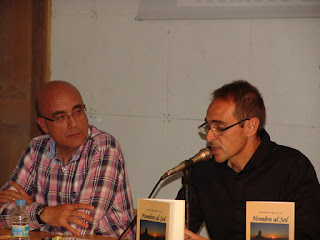
Acompañó en el acordeón el músico Raúl Díaz de Dios.

Aquí reproduzco las palabras del editor, José Torices, que leyó Carlos Blanco:

Y por supuesto, para festejar nos fuimos a nuestro antiguo reducto, El Alcaraván, donde brindamos por nuestro amigo y su libro.

¡ENHORABUENA, ARMANDO!


Fue ante todo una reunión de amigos, muy entrañable y distendida. Estaba la familia de Armando, por supuesto, y multitud de amigos entre los que nos contamos la pandilla de SonLetras.
Nuestro amigo Carlos Blanco Sánchez prologó el libro y acompañó a Armando en la presentación y leyó algunos poemas.


Acompañó en el acordeón el músico Raúl Díaz de Dios.

Aquí reproduzco las palabras del editor, José Torices, que leyó Carlos Blanco:
"Si la poesía es la mejor forma que tenemos los humanos para expresar sentimientos, si expresar esos sentimientos nos reconforta, si a través de ella podemos soñar, viajar, cantar y jugar; cruzar fronteras y alcanzar las nubes; si encontráis felicidad en los pequeños detalles de la vida, sabéis apreciar la belleza natural de las cosas; si estáis enamorados o enamoradas, gozáis de la familia, de los hijos y de los recuerdos; si el compañerismo, la amistad, el espíritu de sacrificio, la abnegación, la camaradería, el honor y la lealtad reside en vuestros corazones; si se eriza aún vuestra piel al ver elevarse y flamear los colores de nuestra bandera, si en definitiva, estáis vivos, os prometo que Armando, “Hombre al Sol”, es la medida de todos esos sentimientos."


¡ENHORABUENA, ARMANDO!
lunes, junio 10, 2013
Alejandra Pizarnik
Diego Manrique Sabogal escribió una reseña muy interesante sobre la poeta en ocasión de la publicación de sus diarios.
http://cultura.elpais.com/cultura/2013/03/21/actualidad/1363892269_536778.html
Árbol de Diana
1
He dado el salto de mía al alba.
He dejado mi cuerpo junto a la luz
y he cantado la tristeza de lo que nace.
He dejado mi cuerpo junto a la luz
y he cantado la tristeza de lo que nace.
2
Éstas son las versiones que nos propone:
Un agujero, una pared que tiembla…
Un agujero, una pared que tiembla…
3
Sólo la sed
el silencio
ningún encuentro
cuídate de mí amor mío
cuídate de la silenciosa en el desierto
de la viajera con el vaso vacío
y de la sombra de su sombra.
el silencio
ningún encuentro
cuídate de mí amor mío
cuídate de la silenciosa en el desierto
de la viajera con el vaso vacío
y de la sombra de su sombra.
Tomado de «Árbol de Diana», en Obras completas. Poesía y Prosas, introducción de Silvia Baron Supervielle, Buenos Aires, Ediciones Corregidor, 1990, pp. 201-202.
La muerte y la niña
Debajo de un árbol, frente a la casa, veíase una mesa y sentados a ella, la muerte y la niña tomaban el té. Una muñeca estaba sentada entre ellas, indeciblemente hermosa, y la muerte y la niña la miraban más que al crepúsculo, a la vez que hablaban por encima de ella.
—Toma un poco de vino —dijo la muerte.
La niña dirigió una mirada a su alrededor, sin ver, sobre la mesa, otra cosa que té.
—No veo que haya vino —dijo.
—Es que no hay —contestó la muerte.
—¿Y por qué me dijo usted que había? —dijo.
—Nunca dije que hubiera sino que tomes —dijo la muerte.
—Pues entonces ha cometido usted una incorrección al ofrecérmelo —respondió la niña muy enojada.
—Soy huérfana. Nadie se ocupó de darme una educación esmerada —se disculpó la muerte.
Tomado de «Devoción», en Prosa completa, edición a cargo de Ana Becciú, prólogo de Ana Nuño, Barcelona, Editorial Lumen, 2002, p. 31.
domingo, junio 09, 2013
Cosecha de verano - Colección de relatos
Mi cuento "Mujer frente a la ventana" ha sido seleccionado para integrar la colección de relatos Cosecha de verano de Editorial Urania.
COSECHA DE VERANO – LISTA DE AUTORES SELECCIONADOS
1. Alberto Pérez
2. Alena Collar
3. Annie Altamirano
4. Arancha Arnau
5. Carmen G. Grandal
6. Carmen García
7. Christa Madrid
8. Elena Torrejoncillo
9. Elisa El Zoughbi
10. Gonzalo J. Mallea
11. Javier García
12. Jorge Encinas
13. José A. Socorro
14. José M. Colmenero
15. José R. Martínez
16. Juan Díaz
17. Manel Aljama
18. Marcelo Díaz
19. Mari Carmen Castillo
20. María Dolores Almeyda
21. María Sentandreu
22. Miguel Torija
23. Paco Tejedo
24. Pedro Gómez
25. Pepa Cantarero
26. Petra Dindinger
27. Pilar Saborit
28. Puri Teruel
29. Rosa Miró
30. Rosario Raro
31. Sicilia Nuño
32. Silvia Cuevas-Morales
33. Tomás Illescas
34. Trini Reina
35. Yolanda Quiralte
ENHORABUENA a todos los seleccionados por nuestro comité lector.

COSECHA DE VERANO – LISTA DE AUTORES SELECCIONADOS
1. Alberto Pérez
2. Alena Collar
3. Annie Altamirano
4. Arancha Arnau
5. Carmen G. Grandal
6. Carmen García
7. Christa Madrid
8. Elena Torrejoncillo
9. Elisa El Zoughbi
10. Gonzalo J. Mallea
11. Javier García
12. Jorge Encinas
13. José A. Socorro
14. José M. Colmenero
15. José R. Martínez
16. Juan Díaz
17. Manel Aljama
18. Marcelo Díaz
19. Mari Carmen Castillo
20. María Dolores Almeyda
21. María Sentandreu
22. Miguel Torija
23. Paco Tejedo
24. Pedro Gómez
25. Pepa Cantarero
26. Petra Dindinger
27. Pilar Saborit
28. Puri Teruel
29. Rosa Miró
30. Rosario Raro
31. Sicilia Nuño
32. Silvia Cuevas-Morales
33. Tomás Illescas
34. Trini Reina
35. Yolanda Quiralte
ENHORABUENA a todos los seleccionados por nuestro comité lector.

miércoles, junio 05, 2013
Recital de SonLetras en Linares de Riofrío


El sábado a la tarde nos fuimos a Linares de Riofrío e hicimos una lectura de poemas acompañados por los poetas Julián Martín, de Carrascal del Obispo, y Javier Sánchez, casi casi de Linares.

El recital se realizó en el salón de la biblioteca municipal, un sitio cómodo y realmente muy grande y tuvimos una gran audiencia. Según nos contaron, hemos batido el récord de aforo.


Luego, el señor alcalde nos invitó a tomar unas cañas a un bar cercano, ¡¡¡regenteado por una familia ARGENTINA!!!!, encantadores todos, que nos atendieron de maravilla y, entre otras cosas ricas, nos agasajaron con EMPANADAS ARGENTINAS. Fueron todo un éxito, no dejamos ni una.

Ya nos han comprometido a regresar en el verano para hacer otro recital, y nosotros obviamente iremos encantados. ¡¡Muchas gracias a todos!!

Suscribirse a:
Entradas (Atom)
Torres de Fantasía
Gracias a la Asociación Homero y en especial a Benito Gonzalez Garcia por invitarme a participar del recital Torres de Fantasía en la Tor...

-
 Se encienden, se desperezan, se agitan, se apresuran, se chocan, se esquivan, se saludan, se ignoran, se distancian, se aceleran, se...
 -
 Esta preciosura de cuaderno me lo hizo Nati, poeta, microrrelatista, artesana, amiga del alma que me ha dado España. Aquí escribiré todo...
 -
 Bar St. Patrick's Museum Obispo Jarrín, s/n Plaza del Mercado Salamanca A partir del viernes 1 de abril, todos los que quieran...